
Like ketchup and mustard or peanut butter and jelly, some things have a clear relationship. Ketchup and jelly don't get along quite so well. Likewise, you can't pair your screw conveyor with just any rotary airlock valve.
Valves and screw conveyors need to work in sync. The wrong pairing can cause issues with buildup or inconsistent material discharge, so follow these tips to make sure both pieces of conveying equipment are working well together.
Transition and rotation
It's important to maintain a smooth transition between the screw conveyor and the rotary valve. The valve's inlet should be configured to let material flow cleanly into the rotor pockets without creating a dead zone or allowing material to build up above the rotor.
You should also consider the direction of rotation to ensure the screw conveyor can naturally feed material into the rotor pockets, rather than have them work against each other. The correct rotation isn't the same in every case: it depends on the screw conveyor's location and configuration.
Two ways to work together
The screw conveyor and rotary airlock valve should be configured to work in tandem. Screw conveyors operate via mechanical rotation, using a helical screw flight to smoothly advance bulk materials through the trough or pipe. Because the conveyor delivers a steady volumetric flow, the rotary airlock valve must be sized to handle the conveyor's maximum discharge rate. This prevents flow restriction and stops material from backing up into the screw.
With that in mind, you can use two different setups: one where the screw conveyor and rotary valve each use an independent drive package, and another where they share a single synchronized drive
Independent setups
Each piece of equipment possesses unique horsepower, torque, and speed requirements. Using independent drive packages — ideally paired with modern, low-maintenance direct drives — gives you the potential for precise, standalone control over the speed of each machine using variable frequency drives (VFDs). More importantly, independent configurations prevent localized mechanical failures (such as a wood chunk jamming the rotary valve) from twisting the conveyor's master shaft or tearing up the main conveyor chain.
When a localized jam occurs, the independent drive acts as an immediate electronic shield. Rather than waiting for a mechanical secondary drive chain to snap or a shaft to bend, a VFD can continuously monitor the motor's operating current. The instant a jam occurs, it can instantly trigger a "jam detection" fault and signal the PLC to shut down the system.
Sharing a drive (Primary and secondary driven equipment)
Sometimes a shared drive setup is more economical or specifically requested by the customer. In a shared drive configuration, the screw conveyor and rotary airlock valve share a single drive package. The screw conveyor acts as the primary drive, directly transferring mechanical power to the secondary valve via a chain or belt arrangement.
Because a chain or belt drive can utilize different sprocket or pulley ratios, the valve does not need to match the exact speed of the screw conveyor. Instead, the drive ratio is engineered so the valve turns at the precise speed required to consistently discharge the volume of material delivered by the screw.
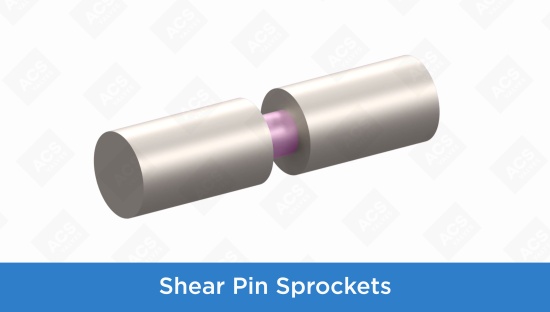
Because a shared drive links both machines, a physical blockage or upset condition in one can stress the entire drive assembly. In this setup, we strongly recommend using a rotary valve with a shear pin sprocket design paired with an oversized shaft. If an obstruction jams the valve, the shear pin will break instantly to isolate the mechanical force, preventing severe damage to both the valve shaft and the primary conveyor drive.
To prevent a broken shear pin from causing a catastrophic system backup, a zero-speed switch should be installed on the rotary valve shaft. Because the primary drive will continue running even after the pin shears, the valve rotor will stop spinning while the screw conveyor keeps feeding material. The zero-speed switch detects this sudden drop in valve RPM and instantly trips the system control circuit, shutting down the master screw conveyor drive immediately to halt the material flow and prevent damage to the screw and rotary valve.
Which drive setup should you use?
While a shared drive functions as a budget-friendly option, our conveying experts strongly recommend independent drives for the screw conveyor and the rotary valve whenever possible.
Options and coatings
Screw conveyors are used to process anything from grains to minerals to plastics, so the rotary valve should be configured to match the application and sized to fit the conveyor. If you're processing food ingredients, for example, you might have a stainless-steel screw conveyor and a sanitary valve with food-grade coatings. The right materials, options, and coatings all depend on your application.
At ACS Valves, we supply CEMA-type screw conveyors in different sizes, shapes, and trough types. If you need something a little different, we can make them in custom lengths or create special inlets and discharges. If you’re looking for high capacity but low profile, we recommend checking out our Trough Style Multi-Port Valve, which can be configured to comply with NFPA 69.
Screw conveyors, rotary valves, and NFPA 69 compliance
If your bulk handling system processes combustible dusts such as wood, grains, chemicals, or metals, compliance with NFPA 69 (Standard on Explosion Prevention Systems) is a critical safety mandate.
Screw conveyors are inherently open, interconnected mechanical pathways. If a deflagration — a fast-moving fire or explosion — occurs in an upstream vessel like a dust collector or silo, the conveyor housing can act as a fuse, allowing the flame front and pressure wave to blast straight through to downstream processes. To mitigate this catastrophic risk, NFPA 69 requires the installation of an approved explosion isolation device.
This is where the rotary airlock valve serves as the system's primary line of defense. The valve isolates the event using a strict flame-quenching design. To legally qualify as an active NFPA 69 isolation barrier, the rotary valve must be custom engineered to meet precise, non-negotiable tolerances.
Get a matching set
Looking for a screw conveyor and rotary valve to match? Don't sweat the details. We'll help you configure both to play well together and fit your application, so you'll always get the best possible material flow. Contact us if you have questions.